Empower clinical decisions with an AI Copilot that distills fragmented multimodal data into a unified consensus.
Evaluating CEREBRA across millions of real-world patient records to deliver state-of-the-art clinical performance.
An interactive, evidence-based AI system that organizes clinical reasoning through coordinated agents to retrieve, analyze, and synthesize information across complex data modalities.
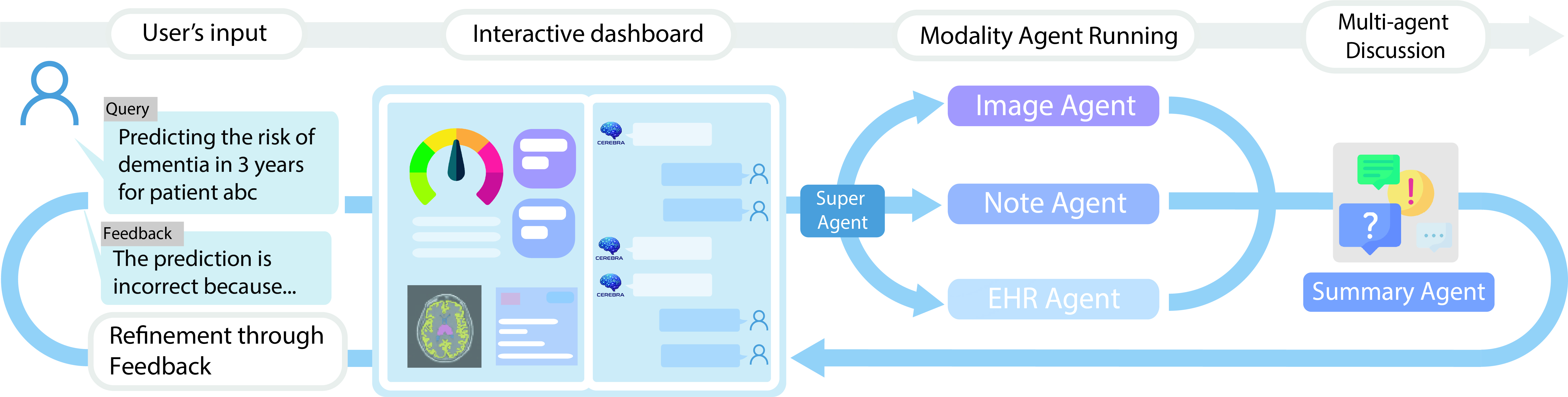
Given a clinician's query via the dashboard, the Data Agent automatically identifies and retrieves the relevant temporal windows and modalities from the patient's fragmented health record.
A central Super Agent decomposes the diagnostic task into specific goals and assigns them to dedicated, modality-specific reasoning agents.
EHR, Note, and Image Agents independently process data, validate models, and produce intermediate probability estimates backed by structured evidence.
The Super Agent aggregates these outputs. Clinicians interact with a transparent dashboard highlighting exact clinical snippets and visual evidence underlying the final analysis.
By analyzing longitudinal health data, CEREBRA achieves highly accurate early prediction of dementia years before clinical onset. Our models are trained on real-world populations to ensure generalizability and reliability over time.
Through robust survival modeling, we are able to provide clinicians with strong concordance in time-to-dementia predictions, outperforming standard baseline models.
CEREBRA acts as an expert clinical assistant, analyzing complex patient profiles to assist in accurate and timely dementia diagnosis.
In rigorous validation across multiple hospital systems, the agent demonstrated state-of-the-art diagnostic performance. When used alongside clinicians, CEREBRA significantly elevates the accuracy of clinical risk assessments.
Healthcare data is notoriously messy and incomplete. CEREBRA utilizes an advanced multimodal fusion architecture that gracefully handles missing data types without failing.
Whether evaluating a complete profile with 3D medical imaging (MRI/OCT) alongside EHR, or functioning purely on sparse structured clinical notes, the agent adapts and maintains robust predictive performance.
Trust is paramount in clinical AI. CEREBRA features specialized agents that not only collaborate to form an assessment but explicitly expose their underlying reasoning.
Through an interactive feedback loop, clinicians can interrogate the agent's logic. The interface allows users to review the exact evidence extracted from clinical notes and imaging markers that led to the final assessment, fostering a collaborative Human-AI diagnostic process.
A controlled study demonstrates that CEREBRA significantly improves diagnostic accuracy, confidence, and clinician satisfaction.
Comparison across diagnosis and longitudinal risk estimation tasks
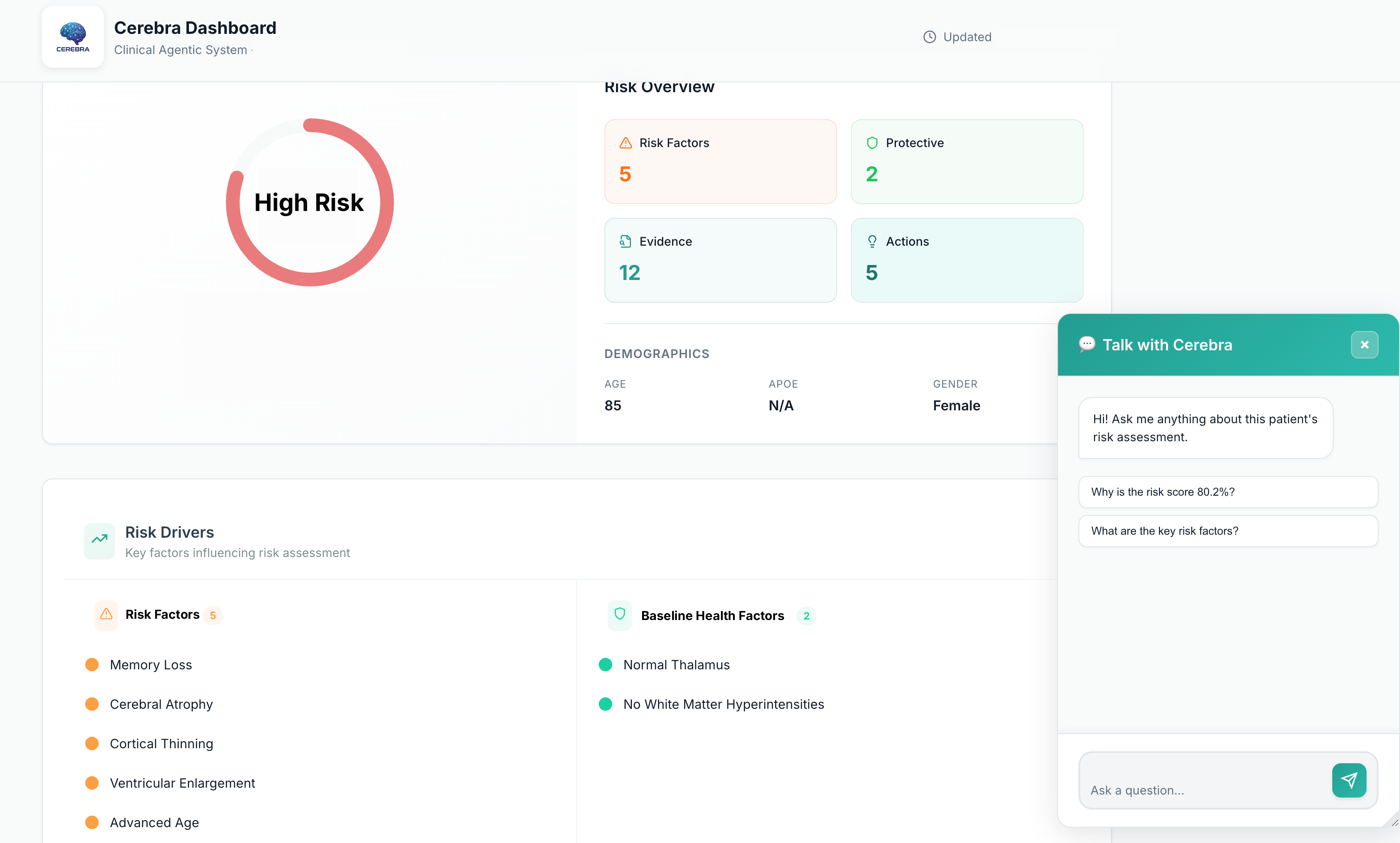
CEREBRA extends dementia risk modeling beyond static predictions toward an interactive decision-support paradigm. Our unified dashboard unifies heterogeneous data for informed, efficient, and transparent clinical assessment.
The dashboard presents overall dementia risk trajectories alongside modality-specific risk factors. For each modality, CEREBRA exposes representative features and clinical snippets that support the various medical tasks, enabling direct inspection of the evidence underlying the model's conclusions.
A multidisciplinary group of AI researchers, software engineers, and clinical specialists dedicated to transforming cognitive care.













 Cerebra